The essence
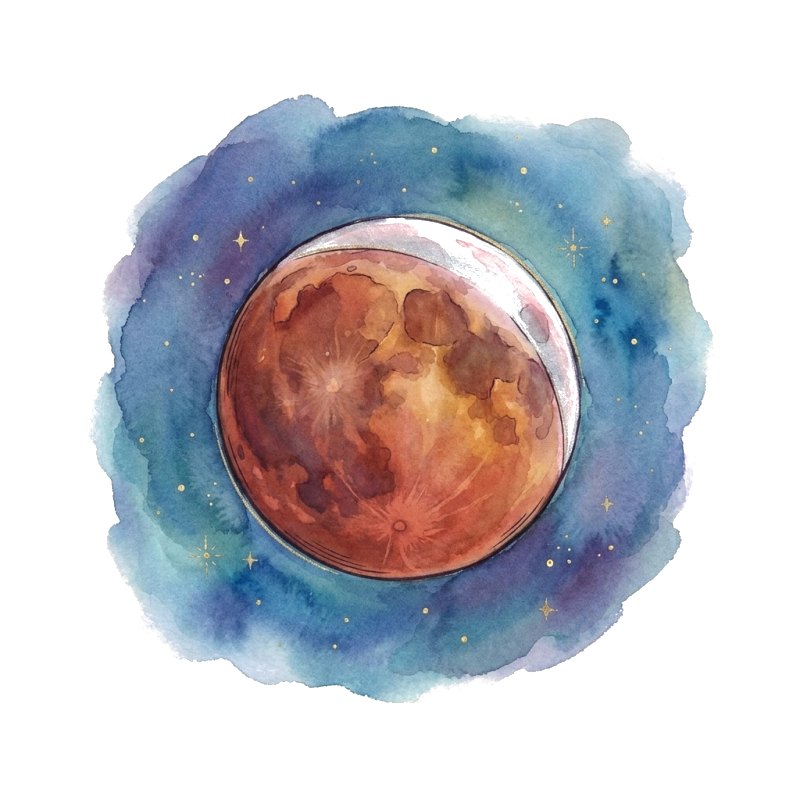
Astronomically, a lunar eclipse needs the Sun, Earth and Moon in a near-perfect line. That only happens when a Full Moon falls close to one of the nodes, the two points where the Moon's tilted orbit crosses the Sun's path. Earth's shadow has a pale outer penumbra and a dark inner umbra. In a total eclipse the whole Moon enters the umbra and often turns coppery red, lit by sunlight bent through Earth's atmosphere. Partial and penumbral eclipses touch only part of it.
Babylonian astronomers recorded eclipses for centuries and noticed they repeat in a cycle of about 18 years, later called the Saros. They read eclipses as omens for the king. In Hindu myth, the demon Rahu swallows the Moon, which slips out again through his severed throat. Aristotle used the curved edge of Earth's shadow to argue that the Earth is round.
Symbolically, the Moon describes your inner life: moods, memory, habits and the patterns learned at home. When the Earth's shadow crosses it, the question is what you have been carrying in the dark. Where a solar eclipse starts something, a lunar eclipse finishes it, bringing to a head what was already building.