The essence
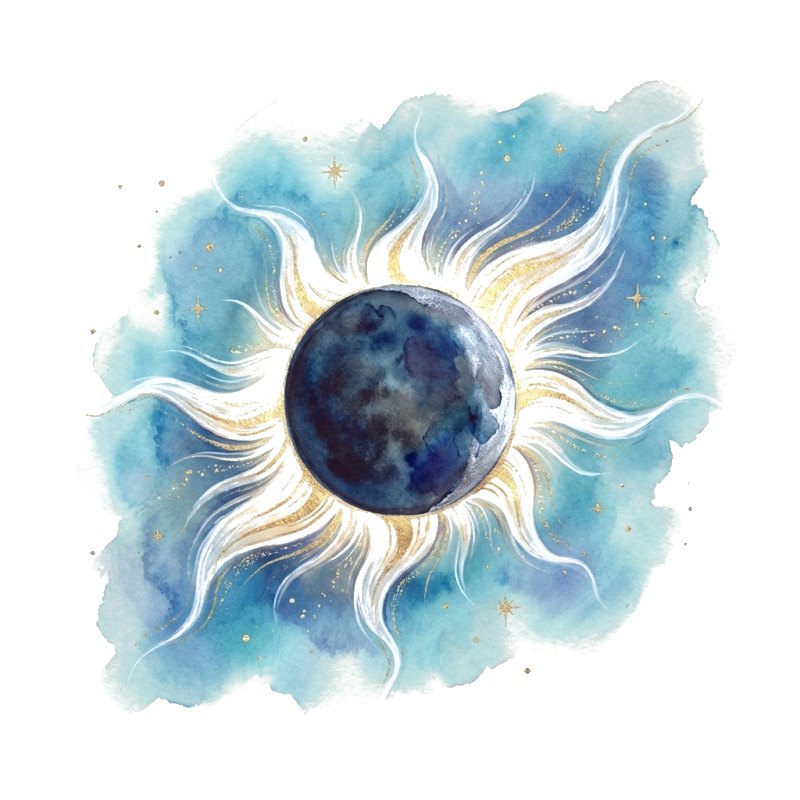
Astronomically, a solar eclipse needs two things at once: a new moon, and the Moon sitting near one of its nodes, the two points where its tilted orbit crosses the Sun's apparent path, the ecliptic. Line those up and the Sun's light is blocked. During a total eclipse, stars and planets appear at midday and birds go quiet. An annular eclipse leaves a ring of fire, and a partial one takes a bite out of the Sun.
People have always read meaning into this. Babylonian astrologers logged eclipses as omens for their kings. Herodotus tells of an eclipse in 585 BCE, said to have been predicted by Thales, that stopped a battle between the Lydians and the Medes. In Hindu myth the demon Rahu swallows the Sun, which is why the north node carries his name in Vedic astrology.
Symbolically, the familiar light goes out so something new can start. Solar eclipses initiate. The house and sign show what part of life is being rewritten, and planets within a few degrees join the story. Effects often unfold across six months to two years.