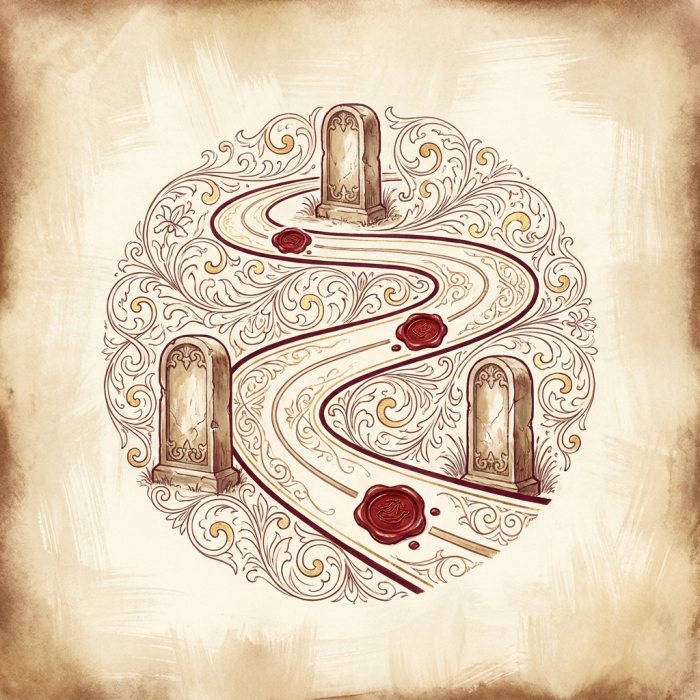
Every retrograde is longer than its headline. Before a planet appears to turn backward, it first walks — in ordinary forward motion — across the very degrees it will soon re-tread. And after it turns direct again, it must cross that same stretch of sky a third time to escape it. Those lead-in and lead-out passages are the shadow periods, and the ground walked three times is where a retrograde does its real work.
This is why the felt experience of, say, a Mercury retrograde so often begins before the official date and lingers past the finish: the story opens when the planet first enters the span, and truly closes only when it finally leaves it.
Essence
The choreography has three beats. On the first pass — forward motion, pre-shadow — the planet crosses a degree and a matter is raised: the conversation begins, the plan is drafted, the question is asked. On the second pass — retrograde — the planet re-crosses the same degree moving backward, and the matter is reviewed: revised, re-negotiated, seen from the other side. On the third pass — direct again, post-shadow — the degree is crossed a final time and the matter is resolved: signed, settled, or consciously released.
The turning points themselves — the stations, when the planet appears to stand still before changing direction — are the most concentrated days of the whole season. A planet spends extra time at its station degree, and astrologers have always read those paused days as the retrograde's loudest moments.
All of this becomes personal only where the re-walked span crosses something in your chart. If the loop contains your natal Sun, the moving planet will visit that exact degree three times, on three knowable dates — a scheduled triple appointment with one theme of your life. If the loop crosses nothing of yours, the season stays general weather.
How It Shows Up
Practically, the three passes are a timing map. Begun something just before the retrograde? Expect the middle chapter to rewrite it — hold plans loosely through the review. Deep in the loop and everything feels unresolved? That is the season working as designed; the third pass, not the second, is where endings live. And the classic counsel for signatures and launches follows the same map: what is signed inside the loop tends to be re-opened, so when a choice exists, the days after the third pass are the solid ground. This is the deeper reason 'wait until the retrograde is over' is only half right — the shadow matters too.
Our free Retrograde Check finds every current and upcoming loop, tells you whether any of them personally cross your natal planets, and dates all three strikes when they do.
A Closing Reflection
Three visits: one to open the question, one to turn it over in the dark, one to answer it. It is the rhythm of any honest reconsideration — which is all a retrograde has ever been. The sky simply does its second thoughts on a schedule, and leaves the dates where anyone patient can read them.