Twelve houses, drawn for the minute and the place you were born.
— Stage I —
Casting your chart
✦❦✧✦☽✧
— Stage II —
Weighing your elements ✦
channeled from the stars
The Five Elements
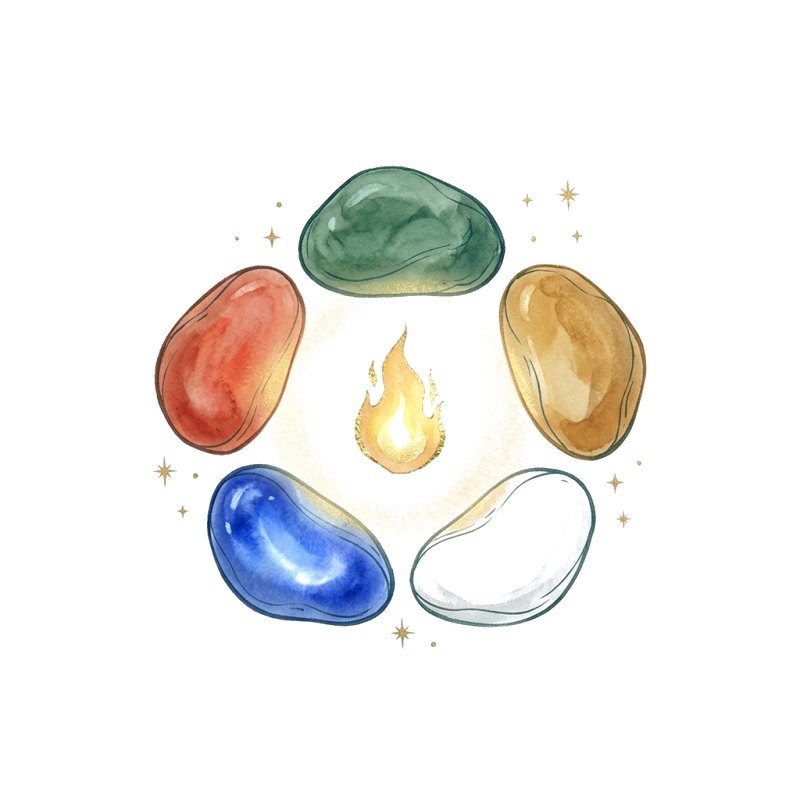
Wood, fire, earth, metal and water move through every chart, yours included. Give me your birth moment and I’ll weigh all five in you, the hidden stems too, and show you which elements help you most.
Your five elements, weighedthe eight characters you can see, and the stems hidden inside each animal
Your Day Master’s strengthstrong, balanced or in need of support, and the season you were born in
Your helpful elementsthe ones your chart needs more of, and how to bring them into your days
Free
Saved to your account
Hidden stems included
Welcome back
We just sent a six-digit sign-in code to your email. Enter it here, then come back and weigh your elements signed in.
Enter your birth details
Your five elements
Your elements
weighed across your four pillars, hidden stems included
Your Day Master’s strength
how much of your chart stands with you, and the season you were born in
Your helpful elements
the elements your chart needs more of, and how to bring them in
Strong, quiet and missing
your strongest element, and the ones you carry quietly or not at all
This year’s elements
Reading this result
Start with the surface count: how many of your eight visible characters belong to each element. Then look at the count with hidden stems, which adds the quieter elements tucked inside each animal. Next comes your Day Master's strength, strong, balanced or weak, which decides your helpful elements, the ones your chart needs more of. Finally, this year's element shows the year's backdrop and whether it adds what helps or more of what you already have.
Go deeper
Your elements are the weather of your chart. Your whole chart, read in full, shows how they move through every pillar.
Your whole chart, read in full · $4.85
The Four Pillars Reading
About 3,500 words on your eight characters: the Ten Gods, the stems hidden in each animal, the strength of your Day Master, and your next two years against every pillar.
Each element feeds the next around the ring, and shapes another across the star.
Generating: each feeds the nextControlling: each shapes another
The two cycles
The oldest picture in Chinese thought for how things grow, and how they are kept in shape.
Sheng, the generating cycle
The Generating Cycle: How Elements Feed
In the generating cycle each element feeds the next, the way one season prepares the ground for the one after it. Wood feeds Fire: dry branches catch and keep a hearth burning. Fire makes Earth: when the flames die, ash settles and becomes soil. Earth bears Metal: ore and stone form slowly inside the hills. Metal carries Water: a cold cup gathers beads of condensation on a summer day. Water feeds Wood: rain soaks the roots and the tree grows. Then the circle begins again. In a chart, the element that feeds your Day Master is your resource, the support you draw from, and the element your Day Master feeds is your outlet, where your effort and expression go. A smooth flow along this circle reads as ease; a missing link shows where the flow is thin.
Ke, the controlling cycle
The Controlling Cycle: How Elements Shape
In the controlling cycle each element checks another, and that check gives form rather than causing harm. Wood parts Earth: roots break up hard ground and hold a hillside in place. Earth contains Water: riverbanks turn a flood into a river you can live beside. Water quenches Fire: a bucket of water keeps a campfire from spreading. Fire melts Metal: the smith's forge turns raw ore into a useful tool. Metal cuts Wood: pruning shears shape a tree so it bears better fruit. Without control, each element would overrun the rest. In a chart, the element that controls your Day Master is your officer, the discipline and responsibility that shape you, and the element your Day Master controls is your wealth, what you work on and manage.
The five, one by one
Each element in its yang and yin form: the two Day Masters it gives.
木
Wood
Wood: The Phase of Growth
SeasonSpring
DirectionEast
ColorGreen
VirtueBenevolence
AnimalsTiger, Rabbit
YangThe great treeYinThe flowering vine
Wood is the phase of growth, the push outward and upward that you see when a seed splits and a shoot finds the light. It belongs to spring and to the east, where the day begins, and its color is green. Its virtue is benevolence (ren), the wish for things and people to flourish. In its yang form Wood is the great tree, rooted and steady, giving shade for decades. In its yin form it is the flowering vine, flexible and clever, climbing whatever support it finds. In a person, Wood looks like someone who starts things: plans a garden, sketches a business on a napkin, encourages the shy friend to apply for the job. They grow toward what matters and bend rather than break.
火
Fire
Fire: The Phase of Brightness
SeasonSummer
DirectionSouth
ColorRed
VirtuePropriety
AnimalsSnake, Horse
YangThe sunYinThe candle flame
Fire is the phase of rising and spreading, the moment growth reaches its height and shows itself. It belongs to summer and to the south, and its color is red. Its virtue is propriety (li), the grace of knowing how to behave so others feel welcome and respected. In its yang form Fire is the sun, generous and impossible to ignore, warming everything at once. In its yin form it is the candle flame, small and close, lighting one table or one face. In a person, Fire looks like warmth and expression: the friend who hosts the dinner, tells the story that makes the room laugh, and remembers to thank the cook. They bring light to gatherings and like to be seen doing it.
土
Earth
Earth: The Phase of Holding
SeasonThe turn of the seasons
DirectionThe center
ColorYellow and ochre
VirtueTrust
AnimalsOx, Dragon, Goat, Dog
YangThe mountainYinThe garden soil
Earth is the phase of gathering and settling, the pause where one movement rests before the next begins. Its season is the turning between seasons, especially late summer, when fields are heavy and harvest is near. Its direction is the center, its colors are yellow and ochre, and its virtue is trust (xin), the steadiness that lets others rely on you. In its yang form Earth is the mountain, unmoved and protective. In its yin form it is the garden soil, soft and fertile, taking in seeds and returning food. In a person, Earth looks like the friend whose kitchen everyone ends up in, who keeps promises, remembers birthdays and stays calm when plans fall apart.
金
Metal
Metal: The Phase of Refining
SeasonAutumn
DirectionWest
ColorWhite and gold
VirtueRighteousness
AnimalsMonkey, Rooster
YangThe swordYinThe jewel
Metal is the phase of contraction and refining, the time when the year draws in, cuts away what is finished and keeps what has value. It belongs to autumn and to the west, where the sun sets, and its colors are white, silver and gold. Its virtue is righteousness (yi), a clear sense of what is fair and right. In its yang form Metal is the sword, decisive and exact. In its yin form it is the jewel, polished slowly until it shines. In a person, Metal looks like discernment: the friend who edits your letter down to what matters, keeps a tidy closet of a few good things, and tells you the truth kindly but plainly.
水
Water
Water: The Phase of Depth
SeasonWinter
DirectionNorth
ColorBlack and deep blue
VirtueWisdom
AnimalsRat, Pig
YangThe oceanYinThe still lake
Water is the phase of rest and gathering inward, the quiet below the surface where the next cycle waits. It belongs to winter and to the north, and its colors are black and deep blue. Its virtue is wisdom (zhi), the kind that listens before it speaks. In its yang form Water is the ocean, vast, moving and hard to hold. In its yin form it is the still lake, calm enough to reflect the sky. Water finds the low path around every obstacle and wears stone smooth with patience. In a person, it looks like curiosity and depth: the friend who reads late into the night, notices what others miss and adapts to almost any room.
The five elements, or wu xing, are Wood, Fire, Earth, Metal and Water. They are better understood as phases of change than as substances: growth, peak, settling, refining and rest. Each has a traditional season, direction, color and virtue. In BaZi, every one of the eight characters in your birth chart carries an element, and the mix shows how your nature is built and which qualities sit in the foreground or background.
How do I find my element in Chinese astrology?
Your personal element is your Day Master, the Heavenly Stem of the day you were born. To find it, enter your birth date, and ideally your birth time, into the tool. It builds your four pillars (year, month, day and hour) and shows the Day Master along with the full element count. Your Chinese zodiac animal comes from the year, but the Day Master is what BaZi treats as you.
What are the generating and controlling cycles of the five elements?
The generating cycle is the feeding circle: Wood feeds Fire, Fire makes Earth as ash, Earth bears Metal, Metal carries Water as condensation, and Water feeds Wood. The controlling cycle is the shaping circle: Wood parts Earth with its roots, Earth contains Water with banks, Water quenches Fire, Fire melts Metal, and Metal cuts Wood. Together they keep the elements in balance, and in a chart they show what supports, expresses, shapes and is managed by your Day Master.
What does it mean if an element is missing from my chart?
A missing element means it does not appear among the eight visible characters of your chart. It is common and not a flaw. First check the hidden stems: the element may be there quietly, inside one of your animals. If it is truly absent, that quality simply sits further from your habits, and you may find it in other people, places and seasons. Whether you need it depends on your Day Master's strength, not on the gap alone.
What are hidden stems in BaZi?
Hidden stems are the Heavenly Stems held inside each of the twelve animals, or Earthly Branches. Each animal holds one to three of them: a main qi, and sometimes a middle and a residual qi. They mean an element can be absent from your eight visible characters yet still present in your chart, quieter and in the background, there to be drawn on rather than leading. Counting them gives a fuller picture of your elements.
What is a helpful (favorable) element and how do I use it?
A helpful element is the one your chart needs more of to come into balance. It follows from your Day Master's strength: a strong Day Master is helped by the elements it feeds, controls or is controlled by; a weak one by its own element and the one that feeds it. Use it in ordinary ways, through traditional colors, seasons, directions, settings, activities and company. These are customs to try, not guarantees.
Explore every tool
Every free reading, chart and calculator on the site, gathered here so you can find yours.