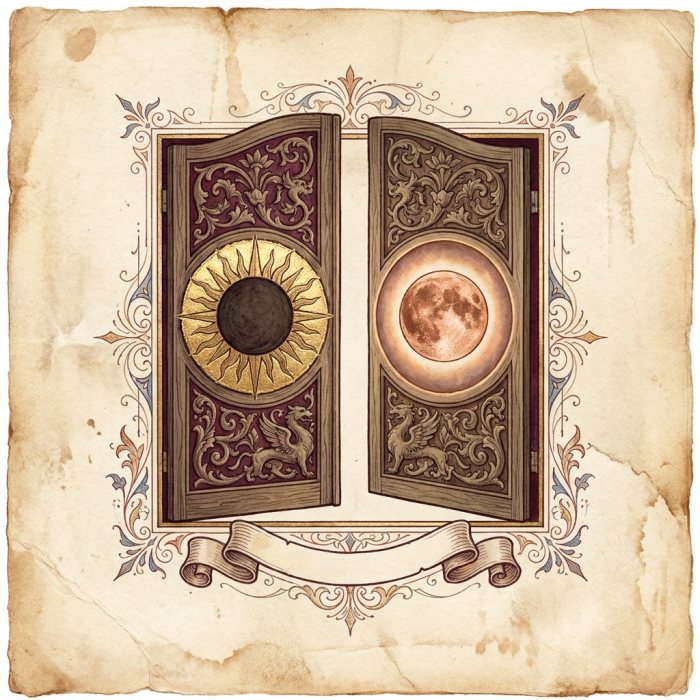
Eclipses do not wander the calendar alone. They arrive in seasons — clusters of two, occasionally three, spaced about two weeks apart, roughly every six months. For a stretch of around three and a half weeks, the sky opens a corridor: a solar eclipse at one New Moon, a lunar eclipse at the neighboring Full Moon, and sometimes one more before the corridor closes.
Astrology has always treated these weeks differently from ordinary time — faster, stranger, more consequential. Doors open that no one knocked on; doors close that everyone assumed would stay open. Knowing when a season begins and ends is half the art of moving through one.
Essence
The astronomy is elegant. The Moon's orbit is tilted about five degrees against the Sun's path, crossing it at two points — the North and South Nodes. Most months, the New and Full Moons happen away from those crossings and nothing blocks any light. But twice a year the Sun drifts close to a node, and for those few weeks every lunation lands in alignment: the New Moon slides in front of the Sun, the Full Moon slides into Earth's shadow. That nodal window is eclipse season. Because the window spans more than one lunar month, eclipses necessarily come in pairs — which is why a lone eclipse standing weeks apart from any partner belongs to no season at all, whatever a dramatic headline may claim.
Symbolically, the pairing gives each season a shape. The solar eclipse is a supercharged New Moon — a beginning you did not schedule, a door swinging open. The lunar eclipse is a supercharged Full Moon — a culmination, a reveal, something carried to fullness and released. One opens, one completes: the season's exhale and inhale. And because the nodes drift slowly backward through the zodiac, seasons repeat in the same pair of opposite signs for about a year and a half — a running story with chapters six months apart.
Shadow & Light
The old counsel for eclipse weeks is patience: watch what arrives rather than forcing what you had planned. Eclipse time is considered poor ground for elections — launches, signings, weddings — not because harm waits there, but because eclipse events tend to belong to a larger story than the one you were writing that day. The light is doing something else.
The other half of the counsel is trust. What an eclipse season removes is, in the tradition's long view, something already finished; what it opens is something already owed. Whether a given season touches you depends entirely on whether its eclipses land on the sensitive degrees of your own chart — most pass a given chart quietly. Our free Eclipse Check maps the next eighteen months of eclipses against your natal placements, dated to the degree.
A Closing Reflection
Twice a year, the sky's two great lights agree to be interrupted — briefly, precisely, on schedule. There is a strange comfort in that: even the interruptions keep an appointment. An eclipse season asks only that you hold your plans a little more loosely for three weeks, and watch what the darkness delivers.