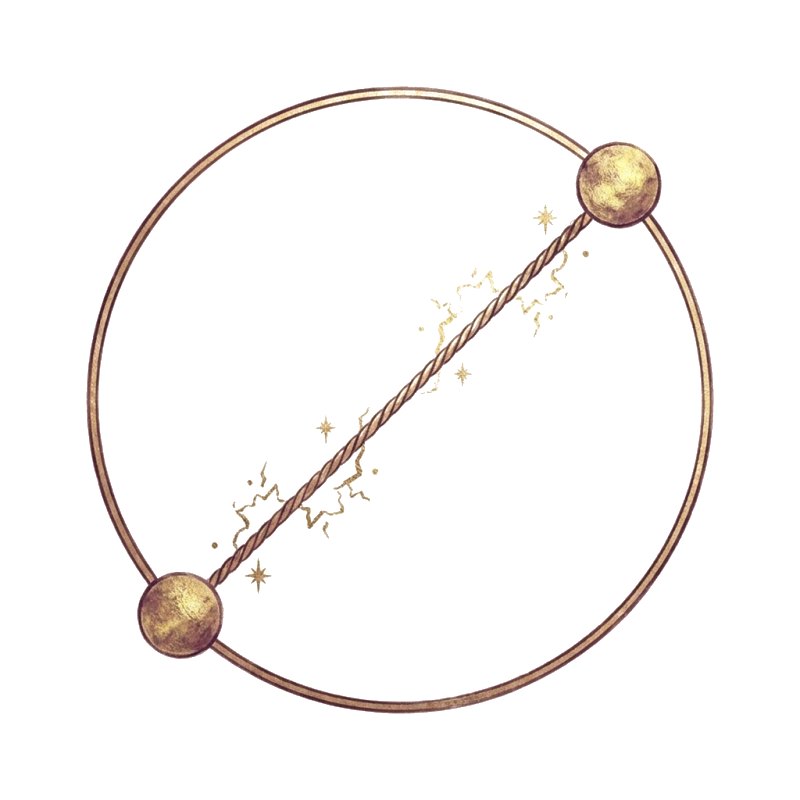
The essence
Take a square (90°) and add half a square (45°), and you land on 135°. That is why it is also called the sesquisquare, from the Latin sesqui, meaning one and a half. It belongs to the eighth-harmonic family, the aspects made by cutting the circle into eight equal slices, alongside the semisquare at 45°. Johannes Kepler, the astronomer who worked out the laws of planetary motion, proposed both in the early 1600s while trying to put astrology on a firmer mathematical footing. Most astrologers give it a tight orb, about two degrees, so it only counts when the angle is close to exact.
Because 135° lands partway into a sign, the two planets share no obvious bond. One wants one thing, the other wants something slightly different, and neither gives way. Say Venus and Saturn form one: you may love warmly yet keep checking whether affection is safe, a small hitch every time. It won't break you, but it will make you itch.