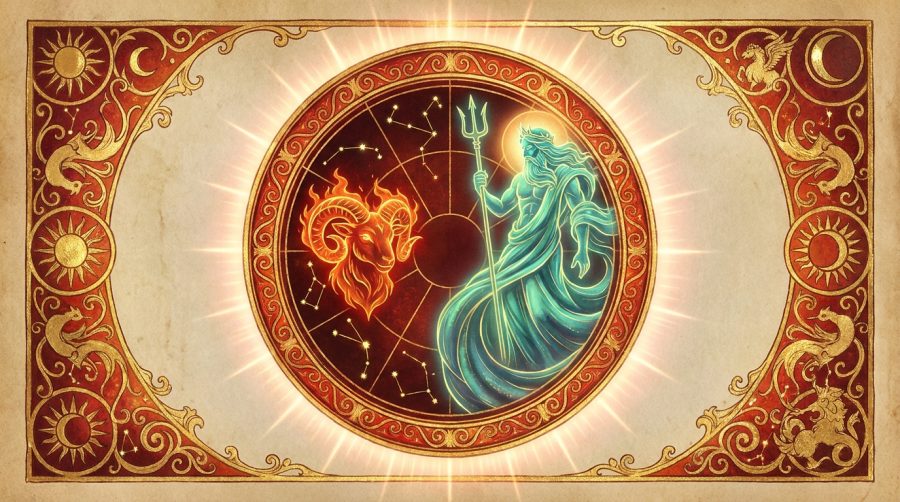
On September 25, 2026 — at 6:33 PM Pacific / 9:33 PM Eastern — Neptune stands at opposition in 2° Aries, positioned directly opposite the Sun. This is the planet's closest and brightest appearance of the year, rising in the east as the Sun sets in the west, and remaining visible across the entire night.
There is something quietly moving about a planet whose whole visibility depends on this kind of alignment. Neptune is never a bright object — even at its best, it asks for a telescope, not a glance. But opposition is the moment the sky arranges itself in Neptune's favor: Earth passes between the Sun and Neptune, and for this one date, the distance between us and that far blue world is as small as it gets, the light bouncing back to us as strong as it gets. It is less a spectacle than a permission — a night when looking for Neptune actually rewards the looking.
What Opposition Means
Opposition is a geometric fact before it is a symbolic one. When a planet is opposite the Sun, it rises as the Sun sets and sets as the Sun rises, meaning it is above the horizon for the entire span of night. For outer planets like Neptune, whose orbits carry them so much more slowly and distantly than ours, this alignment happens roughly once a year, and it is the marker astronomers and skywatchers use to note when a planet is at its most observable. On September 25, 2026, that marker belongs to Neptune, sitting at 2° Aries.
Neptune does not shout for attention. It waits for the one night a year when the sky itself does the work of finding it.
Neptune's Nature
Neptune has always carried the symbolism of dissolution — the planet of dreams, imagination, spiritual longing, and the blurring of boundaries between self and world. It governs what cannot be measured directly: intuition, faith, artistic vision, the ocean-deep parts of feeling that resist explanation. Fittingly, the planet named for the sea is the one whose light takes the longest to reach us and whose form is the hardest to pin down. Even at opposition, even at its brightest, Neptune remains a soft presence rather than a dazzling one. It rewards patience and quiet attention rather than a quick look.
Its placement at 2° Aries adds a particular texture to this year's opposition. Aries is a sign of beginnings, assertion, and raw individual will — the spark that initiates rather than the current that dissolves. Neptune moving through this early degree of Aries brings its characteristic haze and longing into contact with a sign built for clarity and forward motion. It is a meeting of the mist and the flame, the diffuse and the direct.
A Night to Notice
For those who go looking, the practical invitation of September 25, 2026 is simple: Neptune is up all night, rising as the last daylight fades and remaining visible until dawn. Because Neptune sits so far from Earth, it will still appear as little more than a faint, blue-grey point of light even under the best conditions — this is not a planet that dominates the sky the way Venus or Jupiter can. But its presence, however subtle, is honest. It is doing exactly what it does every year at this time: turning to face us fully, if only we take the time to face it back.
- Neptune reaches opposition at 2° Aries on September 25, 2026.
- It rises at sunset and remains visible throughout the night.
- This marks its closest and brightest appearance of the year.
Living with Neptune's Light
There is a kind of astrology that lives entirely in symbol, and a kind that stays close to what the sky is actually doing. This event asks for both. Practically, it is an astronomical marker — the night Neptune is most available to be seen. Symbolically, it is worth asking what in your own life has been waiting for its moment to be seen clearly, even if that clarity comes wrapped in mist rather than sharp light. Neptune's gift has never been precision. It is depth, feeling, and the reminder that not everything true announces itself loudly. On September 25, 2026, the sky simply makes it a little easier to notice what has been quietly there all along.
Layer your birth chart
See why this sky lands for you, right now — your natal placements layered onto the moment, written for your chart alone.