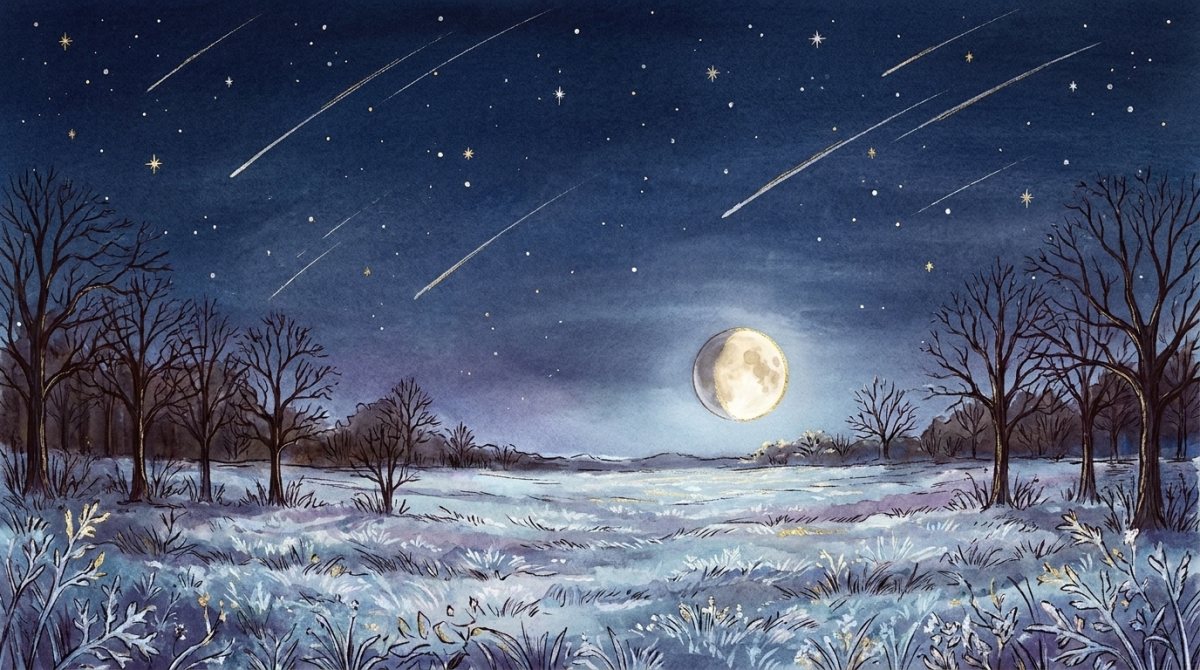
The Leonid meteor shower reaches its peak on November 17, 2026. A partly lit Moon shares the sky, so astronomers would call the viewing fair: not perfect, but good enough to reward anyone willing to step outside, look up and wait. Few sky events ask so little of you. You need no telescope and no chart in hand, only a patch of dark and a bit of patience.
What Is Falling, Exactly
A meteor shower starts with a comet. As a comet swings near the Sun, it sheds a trail of dust and grit, and that trail stays strung along the comet's path long after the comet itself has moved on. The Leonids come from the debris of a comet called Tempel-Tuttle. Each November, Earth's own orbit carries us through that old stream of leftovers.
Most of the pieces are tiny, many no bigger than a grain of sand. When one of them strikes the upper atmosphere at great speed, it heats the air around it until that air glows. What you see as a shooting star is not a star at all. It is a speck of comet dust burning out high overhead, gone in a blink.
The shower takes its name from the stars of the Lion, because the streaks seem to fan out from a single point among them. That point is a trick of perspective. Picture driving through snow at night: the flakes appear to rush toward you from one spot ahead, even though they fill the whole road. Meteors work the same way. They can appear anywhere in the sky, but if you trace their paths backward, they lead home to the Lion.
The Moon matters here. Its light washes out the fainter meteors, which is why a partly lit Moon makes for fair rather than excellent viewing. The brighter streaks will still cut through, and those are the ones people tend to gasp at.
How Astrologers Read Falling Light
It helps to be honest about something. Meteor showers are not part of the classical birth chart the way the Sun, Moon and planets are. They do not rule signs or houses, and you will not find them in most astrological textbooks. Astrologers who pay attention to them tend to read them the way people have long read the night sky in general: as images that carry meaning, rather than as forces that cause events.
The oldest and most familiar of those images is the wish. Folk custom in many places treats a shooting star as a moment to make one, and modern astrologers often fold that custom into their practice. In this reading, a meteor shower is a night of brief openings, small gaps in the ordinary where you are invited to name what you hope for.
A meteor is the debris of something that passed long ago, catching fire for one bright second.
There is a second layer worth sitting with. A meteor is the debris of something that passed long ago, catching fire for one bright second. Some astrologers read that as a picture of how old material in our own lives can suddenly flare into view: a memory, an unfinished hope, a talent you set down years back. It does not come to stay. It comes to be noticed. That is a soulful way to treat the shower, and it asks nothing of you except attention.
Making Room for the Night
If you want to watch, the practical side is simple. A few suggestions for the evening around November 17:
- Find real dark. Get away from streetlights and porch lights if you can. Even a backyard with the house lights off is better than a lit street.
- Give your eyes time. Eyes need roughly twenty minutes to adjust to the dark. Put your phone away during that time, since its screen resets your night vision.
- Keep the Moon out of your view. Face a part of the sky away from it so its glow does not drown the fainter streaks.
- Get comfortable. Lie back on a blanket or a reclining chair. Dress warmer than you think you need; November nights cool quickly when you stay still.
- Expect gaps. Meteors come in clusters and lulls. Several minutes of nothing is normal, and so is the sudden pair that makes you sit up.
If the sky is cloudy where you are, the meaning does not depend on the view. You can still give the evening the same shape: a quiet half hour outdoors or by a window, lights low, a few things you hope for spoken or written down.
A simple practice suits this night well. Before you go out, write down one wish that is honest and specific, something you could actually take a step toward. When a meteor crosses the sky, let it be your reminder of that wish rather than a request to the stars to handle it for you. The next morning, read what you wrote and choose one small action. The streak was brief, but the action is yours to keep.
Let the meteor be your reminder of the wish, not a request for the stars to handle it.
Some people find the shower stirs up older feelings, the hopes they quietly dropped somewhere along the way. If that happens, you do not need to fix anything. Notice what returns. Some of it may be ready to pick back up, and some of it may simply want a kind goodbye.
Finding It in Your Own Chart
Because a meteor shower is not a planet, it does not land in your chart the way a transit does. You can still use it as a prompt to look at your chart more closely. Traditionally, astrologers connect hopes, wishes and the friends who share them with the eleventh house, and they connect the stars of the Lion with warmth, pride and the urge to shine.
Look over the guide printed beneath this note and ask a gentle question as you read: where in my life am I waiting for a bright moment, and where could I make one myself? Then, around November 17, go outside, look up and give the sky a fair chance to answer.