The Chinese astrology library
The Heavenly Stems
Ten signs of the sky
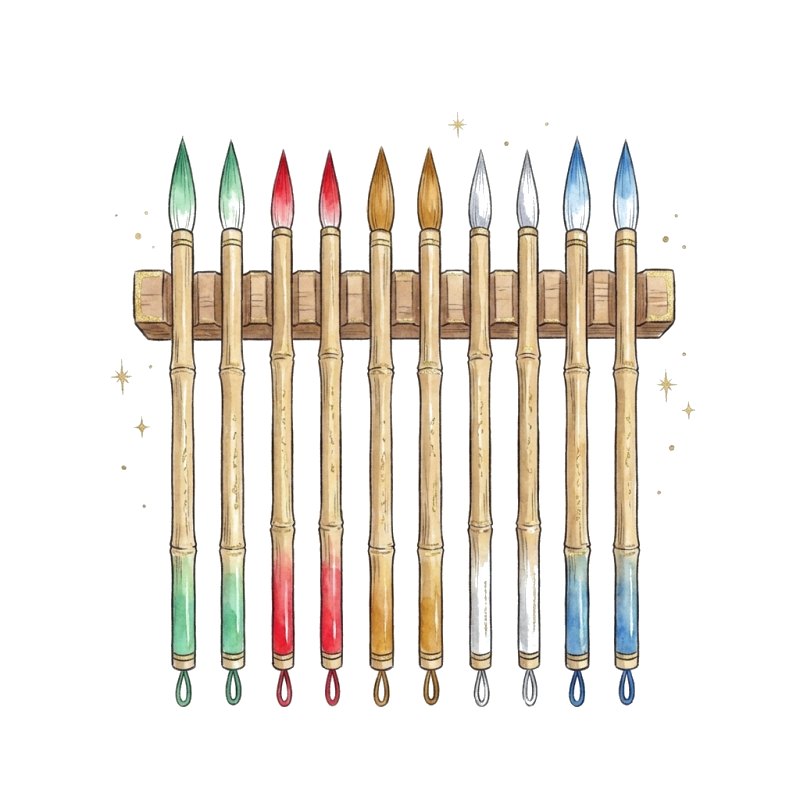
Every pillar of a BaZi chart has a sky half and a ground half. The sky half is one of the ten Heavenly Stems: wood, fire, earth, metal and water, each in a yang and a yin form. Learn the ten, picture them clearly, and you can read the top line of any chart, starting with your own.
Raise your four pillars, freeTen stems, five elements
The Heavenly Stems are a cycle of ten signs. Each one is a single element, wood, fire, earth, metal or water, in either its yang form or its yin form. Yang is the outgoing, solid side of a thing, and yin is the inward, softer side. Five elements times two polarities gives you ten stems. For more on the pairing, see yin and yang.
Each stem has a traditional image, and the images do most of the teaching. Jia, yang wood, is the great tree. Yi, yin wood, is the flowering vine. Bing, yang fire, is the sun. Ding, yin fire, is the candle flame. Wu, yang earth, is the mountain. Ji, yin earth, is the garden soil. Geng, yang metal, is the sword. Xin, yin metal, is the jewel. Ren, yang water, is the ocean. Gui, yin water, is the still lake.
Hold the pairs side by side and the difference is plain. A tree and a vine are both wood, but one stands on its own and the other climbs and winds. The sun lights a whole landscape, while a candle lights one room. Same element, different temperament.
How stems sit in a pillar
A BaZi chart has four pillars: year, month, day and hour. Each one sets a stem above one of the twelve Earthly Branches. The stem is the visible, active layer, the weather over the field. The branch is the ground beneath it, holding the animal and the season. Branches also carry hidden stems of their own, one to three each, which this site counts at weights of 1, 0.5 and 0.3.
Stem and branch step forward together. Ten stems and twelve branches line up again only every sixty steps, so any one pairing returns once in sixty years. 2026 is Bing over Wu, a yang fire Horse year, and the last Bing Horse year was 1966. The year changes at Lichun, around February 4, not on January 1 or at the lunar new year.
Stems also relate to one another. Five pairs combine: Jia with Ji, Yi with Geng, Bing with Xin, Ding with Ren, and Wu with Gui. When two of these meet in a chart, a reader takes note.
Finding your stems
Of the four stems in your chart, one matters most: the stem of the day pillar. This is your Day Master, the element that stands for you. Every other element in the chart is read by how it relates to that one stem, whether it feeds it, drains it, or presses on it.
The free BaZi calculator shows the stem and branch of each pillar. It sets the day by midnight of your birth place's true solar time, and reads the hour the same way. If you don't know your birth time, you'll see three pillars instead of four, and so three stems.
From there, the five elements page tallies your stems with the hidden stems, rates your Day Master as strong, balanced or weak, and names the elements that help it. It's a good next step once you can picture your own sun, lake or mountain.
Keep learning
The rest of the library: five short guides to the Four Pillars.
 The Four Pillars (BaZi)How your birth year, month, day and hour become the eight characters of a BaZi chart.
 The Earthly BranchesThe twelve Earthly Branches: the animals, their elements, their friendships and clashes, and the hours they keep.
 The Day MasterThe one stem in your BaZi chart that stands for you, and the ten forms it takes.
 Yin & YangHow yin and yang double the five elements, split the twelve animals, and color your Day Master.
 Lichun — the Solar New YearWhy your Chinese animal year turns at Lichun in early February, not January 1 or the festival.
See it in your chart
Your four pillars, cast from the exact moment of your birth with the hour read by the Sun, your Day Master and your five elements, with a written reading free. It works even if you don’t know your birth time.
Raise my four pillarsThe Heavenly Stems, answered
What are the ten Heavenly Stems in Chinese astrology?
They are Jia, Yi, Bing, Ding, Wu, Ji, Geng, Xin, Ren and Gui. In order, they are yang and yin wood, yang and yin fire, yang and yin earth, yang and yin metal, and yang and yin water. Each comes with an image: the great tree, the flowering vine, the sun, the candle flame, the mountain, the garden soil, the sword, the jewel, the ocean and the still lake.
Are Heavenly Stems more important than Earthly Branches?
Neither one outranks the other. They are two layers of the same pillar. The stem shows the visible, active element. The branch holds the animal, the season and hidden stems of its own, so it often carries more weight in the element count than it first appears. A full reading always takes stem and branch together as a pair.
Why is 2026 called a fire Horse year?
The stem gives each animal year its element and polarity. 2026 pairs Bing, yang fire, with Wu, the Horse, so it is a yang fire Horse year. Because ten stems and twelve branches realign only every sixty years, the previous Bing Horse year was 1966. The new year itself begins at Lichun, around February 4.
How do I find my Day Master stem?
Your Day Master is the stem of your day pillar. Working it out by hand takes a calendar of the sixty-day cycle, and this site turns the day at midnight of your birth place's true solar time, which can differ from the clock. The free BaZi calculator does this for you. Enter your birth date and place, and it names your Day Master and its element.
Explore every tool
Every free reading, chart and calculator on the site, gathered here so you can find yours.