Reading a Solar Return Chart
A solar return wheel looks like a birth chart, but it is read differently — lighter, faster, and always against the natal chart beneath it. Here is the order a working astrologer looks in.
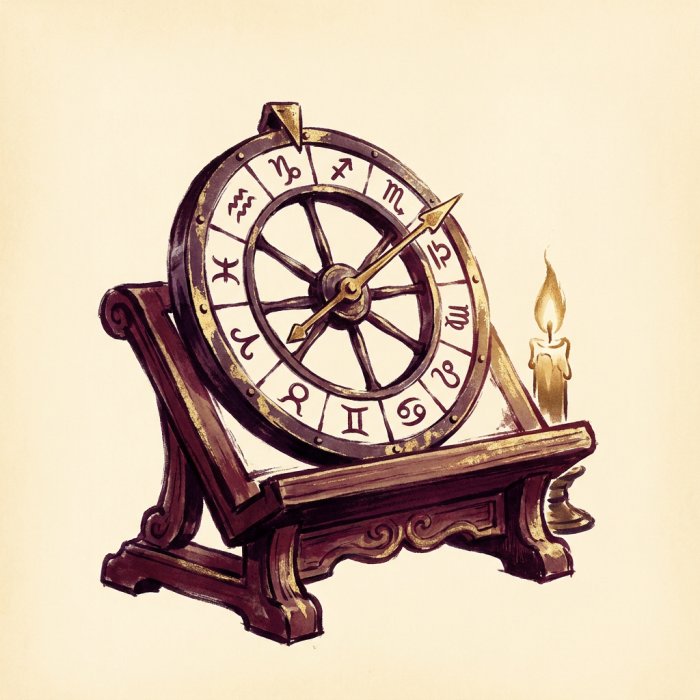
First: the angles
Start with the return Ascendant. Its sign describes the costume the year asks you to wear — the pace, tone, and posture of the next twelve months. A Capricorn rising year feels nothing like a Pisces rising year, even for the same person.
Then the Midheaven: the year's public question, what the world sees you working toward. Any planet sitting tight on one of the four angles is a headline — it will not stay quiet for twelve months.
Second: the Sun and Moon
The house of the return Sun is the single most reliable indicator in the chart — the department of life where the year's vitality concentrates. Whatever that house governs will ask for, and reward, your attention.
The return Moon speaks for the year's emotional weather: its sign shows how feelings run, its house shows what your inner life keeps circling back to. Sun and Moon together give you the year's outer assignment and inner mood in two placements.
Third: the conversation with your natal chart
A return chart never floats free — it lands on a person. The richest layer of the reading comes from comparing the two: return planets falling in your natal houses, return angles conjunct natal planets, a return Sun landing on your natal Saturn or Venus. This is where a generic "10th-house year" becomes your 10th-house year. Read more about that layering in natal vs. solar return chart, or let Selene do the work — the free tool casts your wheel and reads the year for you.
free tool
Cast your solar return
Enter your birth details and where you'll be on your birthday — Selene draws your solar return wheel and reads the year ahead, free.
Cast My Solar Return →Reading a Solar Return Chart FAQs
What matters most in a solar return chart?
Most astrologers weigh the return Ascendant and the house of the return Sun heaviest, followed by the Moon and any planet on an angle. Aspects between return planets refine the picture but rarely overturn it.
Should I read the return chart alone or with my natal chart?
Both, in that order. The return chart alone gives the year's themes; layered over the natal chart it shows how those themes land on your particular life. The comparison is where the specificity lives.
Are solar return aspects read like natal aspects?
The geometry is the same, but the scope is smaller — a return square describes a year's friction, not a lifelong pattern. Read them as this year's weather, using the same grammar you'd use natally.
Can a solar return chart predict specific events?
It maps themes and areas of emphasis rather than fixed events. A 7th-house year makes partnership questions likely; it doesn't guarantee a wedding. The chart describes the season — you still choose what to plant.
The Solar Return Library
 I
I
What Is a Solar Return?
the foundation
II
Reading a Solar Return Chart
the method
you are here III
III
The Solar Return Ascendant
the year's tone
 IV
IV
The Sun's House in a Solar Return
the year's subject
 V
V
The Solar Return Moon
the year's mood
 VI
VI
Birthday Relocation
the lever
 VII
VII
When Does a Solar Return Start?
the timing
 VIII
VIII
Natal vs. Solar Return Chart
the layering
Ready to see your own year? Cast My Solar Return
The Apothecary
Every reading, calculator, and quiet ritual — gathered in one place. Step inside and let the cabinet show you what wants to be seen.
Tarot Readings
Every tarot reading in one place — yes/no, three-card, daily, and more.
Browse allYes or No Tarot
Ask a clear yes or no question — the tarot mirrors back the energy.
Open the readingThree-Card Reading
Three cards for the deeper context behind any question or transition.
Open the readingTarot Card of the Day
A single card pulled fresh each day — soft, soulful guidance for today.
Open the readingFree Birth Chart
Sun, moon, rising — the cosmic map of your soul's chosen lifetime.
Browse allDaily Horoscopes
The current sky themes shaping your week — read for sun, moon, or rising.
Open the readingDeep Readings
Premium chart readings, transit forecasts, and personal astrologer sessions.
Open the readingAstrocartography
Where should you live? Your chart scores 200+ cities for love, money, healing, and home.
Open the readingAsteroid Chart
Ceres, Eros, Lilith, Eris and 12 more — the storied small bodies placed in your natal chart.
Open the readingTransit Chart
The bi-wheel: today's planets circling your natal chart, with your strongest transits explained.
Open the readingChinese Astrology
Your animal, element, and all four pillars — the BaZi chart of your birth moment, free.
Open the readingHuman Design
Your bodygraph — type, strategy, authority — cast free from your birth moment.
Open the readingVenus Sign
Your Venus sign, its house, morning or evening star, and the day Venus next comes home to your degree.
Open the readingDaily Numerology
Today's number, your charts, and every numerology reading in one place.
Browse allLife Path Number
The deeper current guiding your purpose, lessons, and lifetime's evolution.
Open the readingPersonal Day
The energetic tone influencing your mood, intuition, and timing today.
Open the readingHouse Number
The number your home lives at, its personality — and the old remedy for changing it.
Open the reading